Calculators with your own rules
Base prices, surcharges, quantities or distances: inputs and calculation rules are defined so that results can be checked against agreed examples.
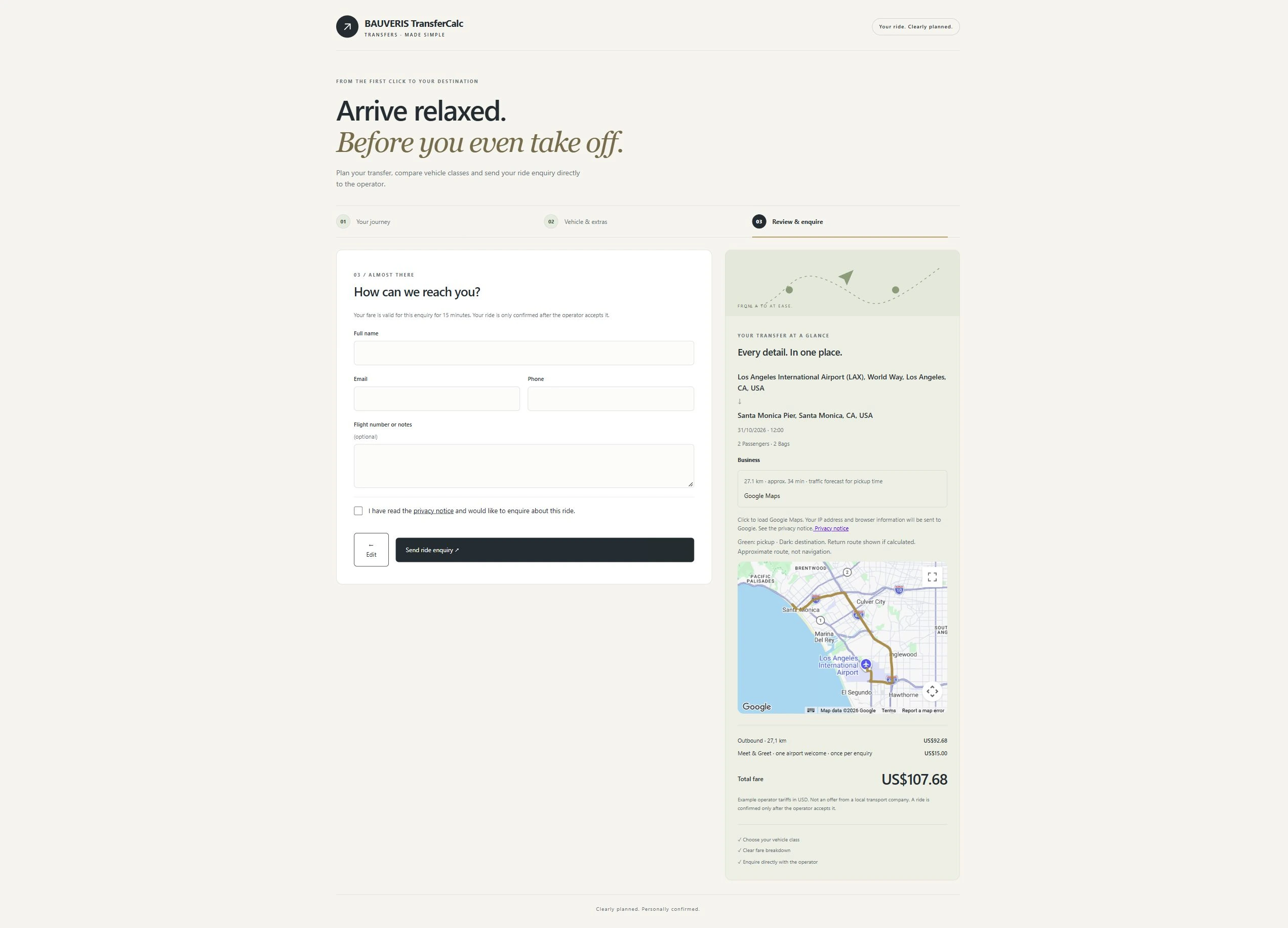
Need a feature built around your own process? BAUVERIS develops custom WordPress plugins, calculators and focused web applications. We define the inputs, business rules, data and integrations before development. TransferCalc, our own WordPress product, shows how a fare calculator and ride enquiry workflow can work together.
 TransferCalc · Relevant work ↗
Base prices, surcharges, quantities or distances: inputs and calculation rules are defined so that results can be checked against agreed examples.
Multi-step enquiries, conditional fields and appropriate status views can support a defined workflow. We plan which data is stored and who can access it.
Where a suitable API is available, data can be sent or retrieved. Access, documentation, running costs and failure behaviour are clarified in advance.
Calculation rules, interfaces, data, integrations and testing determine the development effort. We provide a proposal for the agreed scope after clarifying the requirements. Hosting, external API fees, licences and later extensions are identified separately. Buying TransferCalc provides the described product; commissioning a custom plugin is a separate service.
Packages and pricing scope ↗A custom plugin can be appropriate when existing extensions do not fit your business rules or enquiry process. We first consider whether configuration, an existing extension or a focused custom implementation can solve the task.
If the application should run independently of WordPress, a separate web application may be more suitable. The workflow, users and existing technology guide that decision.
We define examples with expected results, including valid and incomplete input, calculation boundaries, permissions and unavailable external services. These cases support checking the agreed features in the test environment.
Planning also covers installation, configuration, usage guidance and known limits. Source code delivery, usage terms and future maintenance are set out in the proposal.
The task: calculate transfer fares using defined rules and collect non-binding ride enquiries. BAUVERIS developed TransferCalc as its own WordPress product.
The plugin connects vehicle classes, pricing rules and surcharges to an enquiry form. Its administration view supports status management and CSV export. Fixed routes can work without Google; optional Google services require your own credentials and may incur external charges.
TransferCalc is shown here as an example of our development work. It does not confirm bookings or provide payment processing or driver dispatch. Product features and requirements are explained on its product page; a custom application is planned separately.
Clarify the goal, audience, content and technical requirements.
Agree structure, functions, cost and responsibilities in writing.
Develop the design and implementation in a reviewable preview.
Check the agreed functions, resolve feedback and prepare the handover.
Describe your current process, the required feature and an example with inputs and the expected result. WordPress and PHP versions, installed plugins and available integrations are also helpful. Any required access is arranged afterwards.
A WordPress plugin needs a suitable WordPress installation. Hosting, the theme and existing plugins are considered during planning. If the website also needs to be built, the website and plugin can be scoped as separate parts of one project.
Yes, for a clearly defined task. We agree the calculation rules, required fields, validation and expected results. Data storage, email delivery or transfer to another service are included only as agreed parts of the scope.
We agree use cases and expected results, then check the implementation in the agreed environment. Depending on the feature, this includes invalid input, permissions and unavailable integrations. Acceptance criteria and documentation are defined in advance.
Source code delivery, usage terms, documentation and third-party components are addressed in the proposal. Future extensions are assessed against the existing architecture and additional effort, then agreed separately.
Updates, compatibility checks and ongoing support are agreed for the application. TransferCalc has the product-specific terms described on its product page; these do not automatically apply to custom development projects.
For a suitable task, we can plan an external service integration. We clarify API availability, data permissions, ongoing costs and failure cases. Large ERP, CRM or dispatch systems are not automatically part of the service.
Tell us briefly what your business needs. We will review the requirements and suggest a suitable next step.
Discuss your project